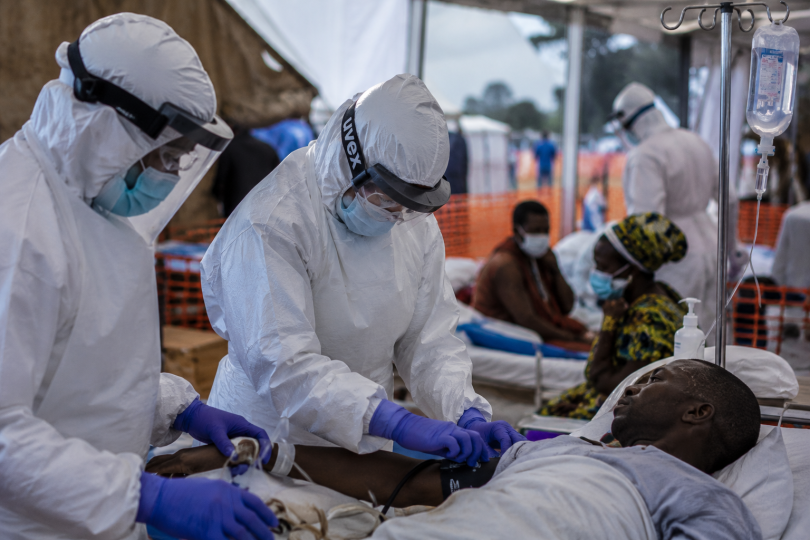

The DRC Ebola Outbreak continues to pose a serious public health challenge, with healthcare workers among the hardest-hit groups since the outbreak was officially declared on May 15. According to the World Health Organization (WHO), the outbreak has already infected 75 healthcare workers, resulting in 17 deaths.
As the virus spreads across multiple regions of the Democratic Republic of the Congo (DRC), health officials are warning that the situation remains critical. New infections continue to emerge, overcrowded displacement camps are increasing transmission risks, and operational challenges are slowing containment efforts.
The outbreak highlights not only the danger posed by Ebola itself but also the immense pressure facing healthcare systems in affected regions.
Healthcare Workers Among the First Victims: DRC Ebola Outbreak
One of the most concerning aspects of the DRC Ebola Outbreak is the high number of infections among medical professionals.
Speaking from eastern DRC, WHO Emergency Director Marie Roseline Belizaire revealed that healthcare workers were among the earliest individuals infected when the outbreak began.
The impact has been severe.
Since May 15:
- 75 healthcare workers have contracted Ebola
- 17 healthcare workers have died
- Medical facilities are facing increased pressure
- Healthcare staffing shortages are worsening
Belizaire described the situation as a significant burden on a healthcare system that already struggles with limited resources.
The loss of trained healthcare workers not only affects patient care but also weakens outbreak response efforts.
Why Ebola Continues to Spread: DRC Ebola Outbreak
The DRC Ebola Outbreak remains difficult to contain for several reasons.
One major challenge is that many patients do not initially display the symptoms people commonly associate with Ebola.
Symptoms Are Not Always Obvious
According to WHO officials, approximately 90 percent of Ebola patients do not initially show hemorrhagic symptoms.
Because of this:
- Many people remain at home
- Patients often self-medicate
- Some seek help from traditional healers
- Cases may go undetected for longer periods
These delays create opportunities for the virus to spread before individuals receive proper medical care.
Early detection remains one of the most important tools for controlling outbreaks.
Handling of Bodies Increases Risk: DRC Ebola Outbreak
Health officials have also emphasized that the body of a person who has died from Ebola can be even more infectious than when that person was alive.
Unsafe burial practices and improper handling of bodies continue contributing to transmission risks in affected communities.
This challenge has been present during previous Ebola outbreaks and remains a significant concern today.
Current Ebola Numbers Show the Scale of the Crisis
The latest figures illustrate the seriousness of the DRC Ebola Outbreak.
To date, authorities have recorded:
- 896 confirmed Ebola cases
- 232 deaths
- Cases spread across 33 health zones
- Outbreak activity reported in three provinces
These numbers demonstrate that transmission remains active despite ongoing response efforts.
Health experts continue stressing the importance of maintaining and accelerating containment measures.
Without sustained intervention, additional outbreaks could emerge in new locations.
Displacement Camps Are Creating New Challenges: DRC Ebola Outbreak
The humanitarian situation in eastern DRC is making outbreak control even more difficult.
According to the United Nations Office for the Coordination of Humanitarian Affairs (OCHA), overcrowded displacement camps are increasing the risk of Ebola transmission.
Conditions in Camps Remain Difficult
More than 270,000 displaced people, primarily women and children, are currently sheltering across more than 60 sites in Ituri province.
Many camps face serious challenges, including:
- Limited access to clean water
- Poor sanitation
- Inadequate healthcare services
- High population density
- Limited disease prevention resources
These conditions create an environment where infectious diseases can spread more easily.
Deaths Under Investigation
OCHA reported that at least 13 people died in two displacement camps in Bunia, the capital of Ituri province, between Wednesday and Thursday.
Response teams are currently investigating whether these deaths are connected to Ebola.
Since April, authorities have documented at least 62 deaths in camps surrounding Bunia.
While investigations continue, the reports highlight the vulnerability of displaced populations.
Why Ituri Province Remains the Epicenter: DRC Ebola Outbreak
The majority of Ebola cases linked to the DRC Ebola Outbreak continue to originate from Ituri province.
According to humanitarian officials, the province accounts for more than 90 percent of confirmed cases.
Several factors contribute to this concentration:
Mistrust of Healthcare Facilities
Some communities remain hesitant to seek medical treatment due to fear or mistrust of health institutions.
This can delay diagnosis and increase opportunities for transmission.
Congestion and Population Movement: DRC Ebola Outbreak
Overcrowding in camps and frequent movement between communities make disease control more difficult.
The more people interact, the greater the potential for Ebola to spread.
Gaps in Prevention Measures
Health authorities continue working to improve prevention efforts, but challenges remain.
Limited resources and difficult conditions can make it harder to implement comprehensive public health strategies.
Africa CDC Highlights Progress and Challenges
The Africa Centers for Disease Control and Prevention (Africa CDC) has acknowledged several positive developments in response efforts.
Testing Capacity Has Improved
According to officials, testing systems have become significantly more efficient.
Current improvements include:
- Nearly eliminating testing backlogs
- Test results available within 24 hours
- Delivery of 21,000 tests to four countries
- More than 27,000 additional tests planned for distribution
The tests are being provided to:
- Democratic Republic of the Congo
- Uganda
- South Sudan
- Burundi
These improvements strengthen regional preparedness and response capabilities.
Funding Remains a Concern
Despite progress, financial challenges continue affecting operations.
During a recent high-level meeting, governments and international partners pledged approximately $910 million for Ebola response efforts.
However, only $90 million has been released so far.
Health officials are urging donors to accelerate funding disbursement so response teams can access the resources needed to combat the outbreak effectively.
Six Critical Challenges Threaten Containment Efforts
Africa CDC experts have identified several major obstacles that continue affecting the DRC Ebola Outbreak response.
1. Lack of Licensed Medical Countermeasures
There are currently no licensed medical countermeasures specifically designed for the Bundibugyo Ebola strain involved in this outbreak.
2. Security Concerns
Armed conflict and insecurity continue disrupting response operations.
Attacks on healthcare facilities create additional risks for workers and patients.
3. Healthcare Worker Infections
The growing number of infected healthcare workers has become what experts describe as an “emergency within the emergency.”
4. Contact Tracing Gaps
Only about 12 percent of expected contacts are currently under active monitoring.
Effective contact tracing is essential for stopping transmission chains.
5. Cross-Border Movement
Frequent movement across national borders increases the risk of regional spread.
6. Funding Shortfalls
Insufficient funding continues limiting the speed and effectiveness of response efforts.
Together, these challenges make outbreak control significantly more difficult.
Understanding Ebola Symptoms
Ebola remains one of the world’s most dangerous infectious diseases.
The virus can cause symptoms such as:
- Fever
- Vomiting
- Diarrhea
- General pain
- Weakness
- Severe illness
- Internal bleeding
- External bleeding
Early diagnosis and treatment remain critical for improving outcomes and reducing transmission.
Public awareness also plays an important role in preventing the spread of infection.
Why Global Attention Remains Important
Although the DRC Ebola Outbreak is concentrated within specific regions, infectious diseases do not respect borders.
The interconnected nature of today’s world means outbreaks can have international implications.
This is why organizations such as WHO, Africa CDC, the United Nations, and international partners continue supporting response efforts.
Global cooperation remains essential for strengthening healthcare systems, improving surveillance, and preventing wider spread.
Final Thoughts
The DRC Ebola Outbreak continues to present a major public health challenge, with healthcare workers paying a particularly heavy price. The infection of 75 medical professionals and the deaths of 17 healthcare workers underscore the risks faced by frontline responders every day.
While improvements in testing, treatment capacity, and international support provide reasons for optimism, significant challenges remain. Overcrowded displacement camps, funding shortages, security concerns, and gaps in contact tracing continue complicating response efforts.
As authorities work to contain the outbreak, sustained international cooperation, rapid funding, and community engagement will be essential. The coming weeks could prove critical in determining whether transmission can be successfully interrupted and lives saved.
Read Other Interesting news here: AI Business Trend